


 ES
ES FR
FR DE
DE IT
IT PT
PT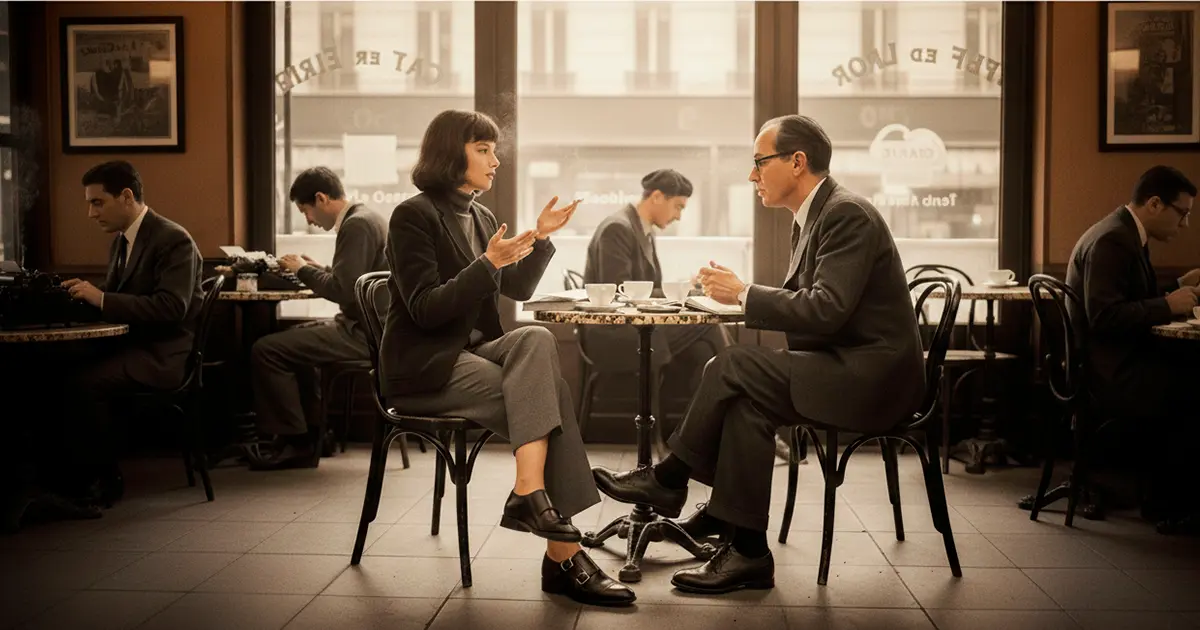
Jan
EXISTENTIALIST STYLE: THE UNIFORM OF ABSOLUTE FREEDOM
Paris, 1945. The Seine carries the moral wreckage of a war that attempted to homogenize the human spirit. But beneath the asphalt of Saint-Germain-des-Prés, in the damp cellars where jazz begins to sound like a machine gun of freedom, the air is different. It doesn’t smell of military victory, but of dark tobacco, bitter coffee, and something far more dangerous: the responsibility of being free.
There they are, both men and women. Those who said No. No to the pomp of the collaborationist bourgeoisie, no to the pastel colors of false peace, and no to the gender roles that history had predetermined for them. On the Left Bank, thought became flesh and philosophy transformed into an aesthetic of resistance. Existentialism was not just a literary movement; it was the first great modern subculture that understood that clothing is a manifesto.
The Attitude: A Radical Modernity
What we now call the “modern mindset” was born at the tables of the Café de Flore. The existentialists were the first to live without a safety net. Their attitude toward life was based on the premise that there is no divine or biological “instruction manual.” We are thrown into the world and are, quite literally, what we decide to make of ourselves.
This attitude was electric. It translated into an insatiable curiosity, a rejection of excessive private property (they preferred to live in hotels and write in cafés), and a complete openness to human relationships without labels. They lived with an urgency we would envy today: they knew that time is the only resource that cannot be recovered. Their modernity lay in understanding that authenticity is not found, it is built.
Their Style: The Rebellion of the Sovereign Woman
If anything broke the mold on the Left Bank, it was the figure of the existentialist woman. Led by the legacy of Simone de Beauvoir, these women shattered the prevailing concept of “femininity.”
- The Armor of Intellect: They adopted men’s trousers and leather or corduroy jackets. It wasn’t a disguise, it was a declaration of equality: a woman discussing ontology with Sartre needs clothes that allow her to move freely, sit on the floor of a jazz club, and walk for miles through Paris.
- The Smoky Gaze: Their aesthetic style was one of austere elegance. Their hair was worn straight or short, without the artifice of bourgeois hairdressers. Makeup was limited to a heavy black eyeliner, creating a deep gaze that always seemed to look into the abyss.
- The Flat Shoe: It marked the end of the heel as an imposition. Existentialists loved flat shoes and leather loafers. They needed stability for their daily revolution. In that choice lay a supreme elegance: that of someone who doesn’t need to elevate herself physically to stand out intellectually.
Their Style: From Rigor to Beatnik Rhythm
The men of the Left Bank —Sartre, Camus, Vian— abandoned the rigid three-piece suit for an aesthetic of a “thought worker”.
- The Rolled-Up Collar: It became the centerpiece. By eliminating the tie, they eliminated the social constraints. The black turtleneck sweater was minimalist, functional, and focused attention on the face and the words.
- Corduroy and Gabardine: Hard-wearing fabrics, made to last. Corduroy evoked a connection with the working class, while gabardine suggested the “outsider,” the observer who never stays too long in a comfortable place.
- Honest Footwear: Lace-up boots or sturdy leather shoes. They were walkers of the asphalt. Their shoes had to be like their thinking: solid, honest, and capable of aging with dignity.
Black: The Color of Total Concentration
Why did black become his obsession? It wasn’t a matter of mourning, but of purity. In a world saturated with distractions, black was visual silence.
- Elimination of the Ego: Blackness leveled the playing field. In a jazz club, the son of an aristocrat and a scholarship student dressed alike. The only thing that distinguished them was the brilliance of their ideas.
- The Elegance of Disdain: Wearing black was a way of showing elegant contempt for fleeting fashions. It was choosing a uniform that would never go out of style because it was never “in fashion.”
- Visual Modernity: Black projected an image of urban sophistication that we still associate with the artistic and intellectual avant-garde today.
Beauvoir and Existential Feminism
Simone de Beauvoir didn’t just write The Second Sex; she was the second sex reclaiming the first. Her attitude—maintaining an open relationship with Sartre, never marrying, not having children due to social pressure—was the ultimate expression of existentialist freedom.
She taught a generation that women’s freedom began with economic independence and ended with sovereignty over their own aesthetic. An existentialist woman didn’t dress to be looked at; she dressed to be. This is, perhaps, the most enduring lesson they left us.
Why are they more relevant than ever?
Today, in 2026, surrounded by algorithms that decide what we should buy and how we should think, the “People Who Said No” are our guiding light.
- Against “Bad Faith”: Sartre called saying “I have no other option” “bad faith.” Today, saying “the algorithm recommended it” is the new bad faith. Reclaiming control of our decisions, from what book to read to what shoes to buy, is an act of existential resistance.
- The Search for the Real: In a digital and ephemeral world, noble materials (leather, wool, cotton) and objects that last (good handmade shoes) are our connection to reality.
- Engagement: It is not enough to observe; we must act. Existentialists taught us that neutrality is a form of complicity.
Conclusion: Walk Your Own Truth
At Beatnik Shoes Club, we understand that choosing a pair of shoes is not a trivial act. It’s the foundation upon which you stand to say your own “No” to the world.
The elegance of the Left Bank hasn’t died; it lives on in every person who decides that their essence isn’t defined by a label, but by their actions. When you put on shoes inspired by that era, you’re embodying a philosophy of life: that of those who dare to be free, to wear black, and to walk on the left bank of the river, where ideas still burn brightly.
Walk with the firm step of Beauvoir. Walk with the rebelliousness of a Beatnik. Walk knowing that, in a world of shadows, your authenticity is the only light that matters.